
Liveness Detection on Face Terminals: Why Cheap Ones Fall to a Photograph
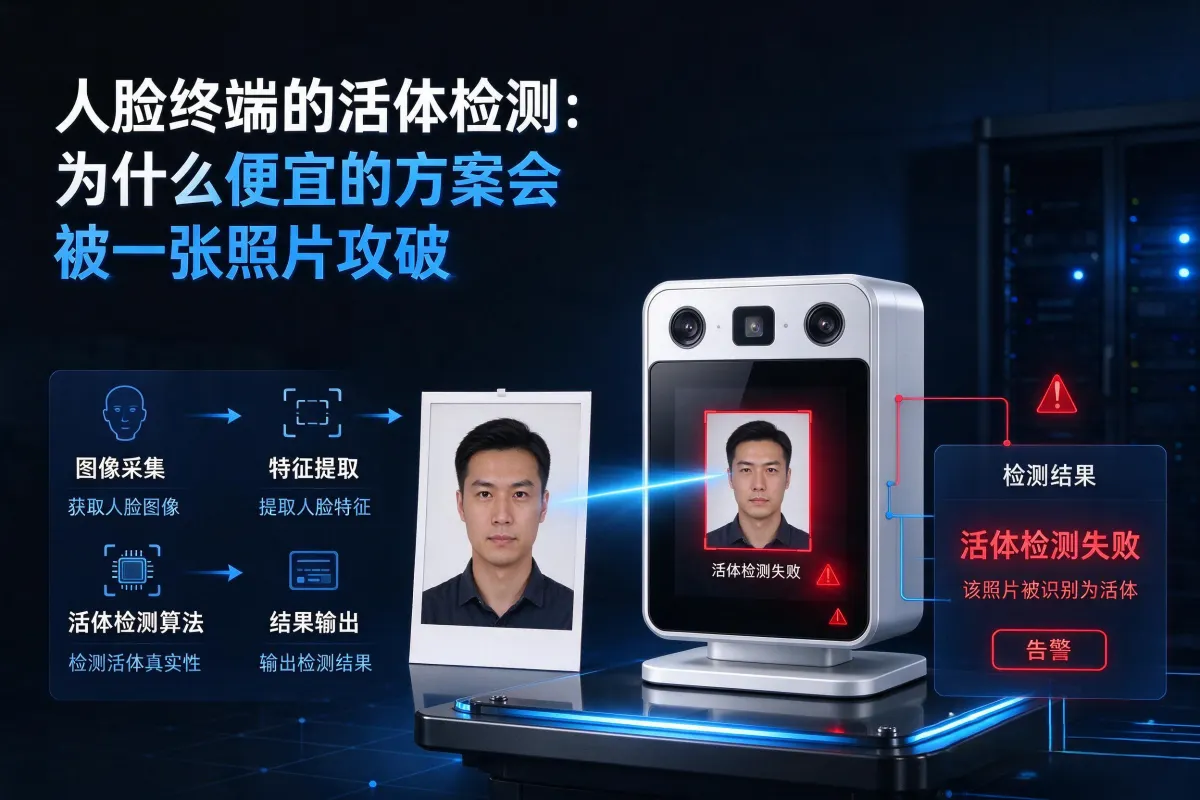
Face access control and face payment terminals range from a few hundred to several thousand, and much of that gap is liveness detection. This article explains something counter-intuitive: whether a photograph fools the device is decided less by algorithm marketing than by whether the hardware has an extra physical dimension.
What a photograph defeats
Face recognition on an ordinary visible-light camera is essentially matching a flat image. Hold a printed photo in front of the lens, or show a high-resolution photo on a phone screen, and early systems — and the cheapest devices today — pass it. That is the photo attack.
The video attack goes further: play a clip of a person blinking and turning their head in front of the lens and you defeat liveness checks that rely only on cooperative motion. This is not theoretical; the tooling is public.
Two approaches to liveness
· Cooperative liveness: the user must blink, open their mouth, turn or shake their head, and the movement of key points decides whether a live person is there. Cheap, but every user has to cooperate, queues slow noticeably at peak times, and defence against video attacks is limited · Silent liveness: no action required. The algorithm reads skin texture, reflection behaviour, micro-movement and optical flow. Better experience and faster passage, at a far higher cost in algorithm and compute
Hardware is the real dividing line
· RGB single or dual camera: visible light only, a flat two-dimensional input, and the algorithm can only guess. The ceiling is low · Infrared dual camera: one near-infrared active illumination path plus one visible-light path. The reflectance behaviour in the infrared image separates a flat photo from real skin — a modest cost increase for a large gain · 3D structured light or ToF: depth is measured directly. Photos and masks give themselves away on the depth map immediately. Strongest protection available today, and the most expensive
Put simply: resistance to photo attacks does not come from what the algorithm datasheet claims. It comes from having infrared or depth as a physical dimension. With visible light alone, no amount of optimisation escapes working on the same flat image.
Four questions to ask before buying
· Is the camera RGB single, RGB plus infrared, or depth-based structured light / ToF? · Is liveness cooperative or silent, and does the silent mode stop screen replay and printed photos? · Is there a third-party test report? In China the common reference is the Bank Card Test Centre liveness certification, which has defined grades · What are the false accept rate (FAR) and false reject rate (FRR)? Always ask for FRR at a stated FAR — a bare "99% accuracy" tells you nothing
Speed and capacity: read past the brochure
The engineering metric that matters is 1:N matching speed. With a gallery of ten thousand faces, recognition normally has to stay under one second. Above thirty thousand you generally need grouping by department, class or building, or queues build up at peak.
And remember site conditions: backlighting, masks, hats and dim lighting all pull accuracy down. The "supports 100,000 faces" line on a brochure usually refers to storage capacity, not matching performance. Make the supplier test on your site rather than trusting a demo video.
Privacy and compliance cannot be retrofitted
A face is biometric data, and many jurisdictions regulate collection, storage and cross-border transfer: notice, consent, local encrypted storage, and deletion on request. For export projects, confirm local rules before shipping — discovering non-compliance once the devices are mounted on the door is far too late.
Bottom line
Choose in this order: first the physical dimension (infrared or depth), then the third-party certification, and only then parameters and price. Selecting on price and accuracy alone tends to get you an attractive door that is not actually secure.