
From Card Swiping to Contactless: Campus Card Payment Renovation Enters the Multi-medium Parallel Period
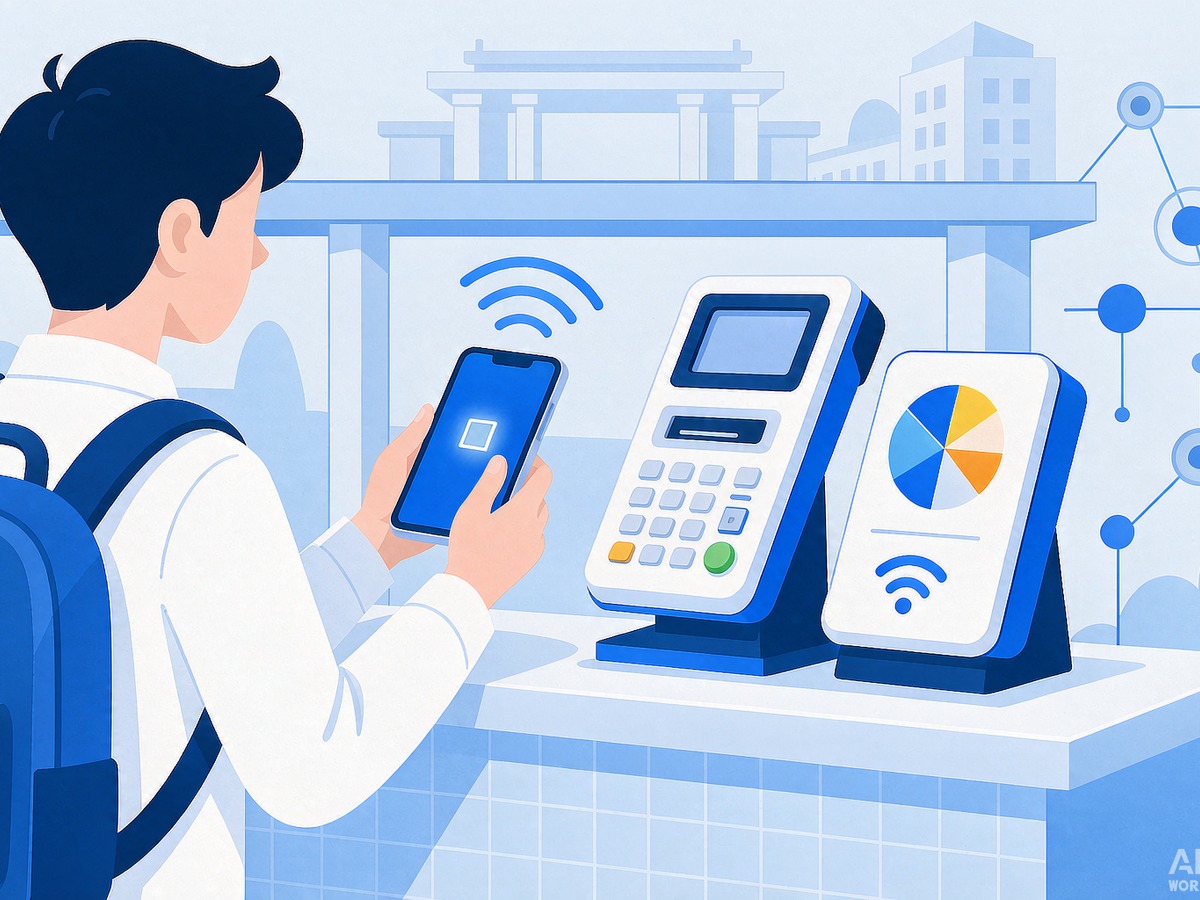
[Weekly Observation] The campus card "replacement season" is busier than usual As the autumn semester of 2026 gets underway, campus card system upgrades have landed at universities across China in a concentrated wave. Unlike the single-point substitution of a few years ago — "swap the physical card for a QR code" — this round shares one defining characteristic: the number of payment credentials is growing, not shrinking. [Move 1] China University of Petroleum, Beijing: a 15-year-old system retires, NFC contactless payment goes live China University of Petroleum (Beijing) completed its digital campus card system upgrade over the summer. According to the university, the legacy system had been running for 15 years and supported only a single physical card: inconvenient to carry, easy to lose, and burdened with a cumbersome loss-reporting and reissue process, with data not connected to the university data centre. The upgrade was carried out off-peak across more than 200 canteen consumption terminals and more than 630 sets of bathroom water-control devices, with installation scheduled during night hours and gaps between meal and bathing periods. Nearly 24,000 faculty and student account balances were migrated with zero errors, and more than 20,000 new physical cards were batch-produced and verified. After the system went live in late August, canteens, retail outlets, the university clinic and the library supported three payment methods simultaneously — physical card, campus QR code and native WeChat code. On 14 October, the university's Information Management Office officially activated NFC contactless payment: faculty and students can provision an NFC virtual campus card on their phone and pay by tapping at canteen and supermarket POS terminals without even waking the screen. [Move 2] Guangdong Ocean University: the digital RMB hard wallet enters campus On 18 September, the country's first campus one-card project built on a super-SIM digital RMB hard wallet was officially launched at Guangdong Ocean University. Guided by the university and the local branch of the central bank, and implemented together with financial institutions and telecom operators, the project integrates mobile communications, campus identity authentication and digital RMB payment for the first time, serving close to 50,000 faculty and students. The technical differentiator is offline payment: after replacing their SIM with a super-SIM card, Android users can complete a "tap" payment with the screen off, with no network, and even with the phone powered down. iOS users pay through a bound app. A lost card can be remotely reported through the official digital RMB app, and after graduation the super-SIM card can be converted into an alumni card that retains campus benefits. On 21 October, the project received feature coverage from Huanqiu.com. [Move 3] The institutional floor: the digital RMB is repositioned The institutional layer is moving in parallel. At the Financial Street Forum annual conference on 19 October, People's Bank of China Governor Pan Gongsheng stated clearly that the digital RMB is being repositioned from cash to deposit money, with the number of operating institutions expanding from 10 to 30, covering all systemically important banks. For campus deployments, this means the fund attributes and protection mechanisms behind digital RMB wallets are being aligned with the commercial bank deposit system. [Why it is hard] The real barrier is not "swapping the machines" Put these three developments together and the difficulty of campus one-card upgrades becomes remarkably consistent: First, account migration is riskier than terminal replacement. The mapping between old and new accounts requires transaction-by-transaction verification, dual-person review and full audit trails — any single error is amplified into a group complaint at a canteen window. Second, terminal replacement must not cause downtime. University canteens have clearly defined peak windows, so devices can only be swapped off-peak — and the terminals themselves must keep working through network and power interruptions. Third, long-tail devices are heterogeneous. Access control, water control and library self-service machines are typically stacked up from different eras and different protocols, so the retrofit sequence must follow "identity unification" rather than "procurement convenience." Fourth, multi-credential coexistence is a long-term norm, not a failed transition. Physical cards, QR codes, NFC and digital RMB hard wallets will coexist for a considerable time, and the system must accept that one person can hold several credentials. [Product Fit] ShenZhen nowgre IOT Technology Co., Ltd. Against these requirements, the campus product line of ShenZhen nowgre IOT Technology Co., Ltd. maps onto three stages: 1. Consumption terminals. The face-recognition consumption machine series (desktop / wall-mounted) is built on an RK3568 quad-core Cortex-A55 processor (1.8 GHz) running Android 11, with 2 GB DDR3 memory and 32 GB eMMC storage. The operator screen is a 5-inch RGB TFT (800x480) and the customer-facing screen is a 7-inch MIPI TFT (1024x600) with a G+G capacitive multi-touch panel. Payment natively covers face, NFC and physical card, with QR code as an option — precisely covering the "card - QR - NFC" transition period. On the communications side, Wi-Fi, RJ45 Ethernet and 4G (optional) are all available, supporting deployment under the varied network conditions of dormitories and canteens. Face recognition uses the Megvii algorithm, with a 20,000-face database that can be expanded; the camera is a 2-megapixel wide-dynamic unit with fill light, suited to backlit canteens and night-time use. For the "no downtime at peak" requirement, the device carries a 3,500 mAh backup battery providing 3-4 hours of operation after a power failure. Seven consumption modes are supported — manual, fixed, menu, download, meal collection, count-based and time-based — covering canteens, supermarkets and water control. Operating temperature is -10C to 50C, storage -40C to 80C. Model NG7105WT supports Wi-Fi plus TCP/IP wired networking; NG7105MP is the 4G version. The series also supports Alipay delegated deduction (per-transaction), which requires merchant onboarding and applies to campus scenarios on the cloud edition only. A tablet face-recognition consumption machine is also available, with an RK3399 hexa-core Cortex-A72 processor, Android 7.1, 4 GB DDR4 and 16 GB eMMC, an 8-inch 1280x800 touchscreen and an aluminium alloy housing, operating from -10C to 60C, suited to mobile checkout and temporary points. 2. Identity credentials. The palm-vein and QR-code all-in-one terminal serves as the fallback for "no card, no code" scenarios: it manages four credential types — card, password, QR code and palm vein — and adds access control management (opening mode, opening interval, card-swiping mode, card number output, Wiegand output, RS485 and baud rate) plus elevator control. Communications include Wi-Fi, static IP, HTTP server and MQTT server configuration, with a network diagnostics tool. On the data side it offers palm-vein data anomaly repair and passage-record export. For international students, foreign faculty, or anyone who cannot conveniently carry a phone, palm vein provides a path that does not depend on terminal battery power. 3. Access control. The access control series covers the NG 86R QR-code password reader and the NG 87 / NG 87EK / NG 87EG QR-code cloud access control all-in-one units. The whole family runs on an Xtensa 32-bit LX6 dual-core processor (600 MIPS) with a FreeRTOS embedded system, supporting QR codes, IC cards, CPU cards, ID cards, phone NFC and Bluetooth. Supported symbologies are PDF417, Data Matrix and QR Code, with read speed under 0.2 seconds and a scan distance of 5-15 cm. Interfaces include Wiegand 34/26, RS485, RS232 and TTL level signals; the NG 86R can connect to controllers of any brand, enabling incremental retrofits of existing access control systems without full replacement. Storage capacity is 30,000 users on the NG 86R and 60,000 on the NG 87 series. Protocols cover HTTP, MQTT and TCP/IP. The NG 87EK / NG 87EG support 4G (LTE Cat.1), Ethernet and Wi-Fi, with remote door opening, cloud platform and mini-program management, and open APIs for third-party platform integration. The series is rated IPX65 with a 9H tempered glass panel and operates from -20C to 70C. [Selection Advice] First, rank payment credentials by "high frequency first, offline as fallback." Canteens and supermarkets should prioritise face and NFC throughput while keeping the physical card channel as the extreme-case fallback. Second, when phasing terminal replacement, prioritise network and power redundancy. Terminals offering wired, Wi-Fi and 4G uplinks plus a backup battery give a much wider installation window. Third, share one identity database between access control and consumption. Avoid the "card works in the canteen but fails at the dormitory door" problem — the root cause of complaint volumes that rise rather than fall after an upgrade. [Closing] This round of campus one-card upgrades is not essentially a "payment method upgrade" but a "campus identity system rebuild." Payment is simply the most visible surface layer. What actually determines project success is zero-error account migration, no-downtime terminal replacement, and unified onboarding of long-tail devices. Only suppliers who can do all four solidly have the standing to talk about "frictionless."